








In most organizations, accounts payable operates at a remarkable scale. Thousands of invoices are processed every month. Payments move across multiple systems. Vendors submit bills in different formats. Teams work under pressure to ensure suppliers are paid accurately and on time.
Yet even in highly controlled environments, mistakes happen. Duplicate payments slip through. Contract pricing is applied incorrectly. Credits remain unapplied. Rebates are missed. Individually, these issues may appear insignificant. Across millions of transactions, however, they can quietly add up to substantial financial leakage.
This is why many organizations conduct an account payable recovery audit. The objective is not simply to identify errors. It is to recover lost value, strengthen controls, and create greater visibility into the accounts payable process. What many finance leaders do not see is the amount of work that happens behind the scenes. A successful recovery engagement follows a structured process that moves from data collection to claim resolution.
Let's examine each stage of that journey.
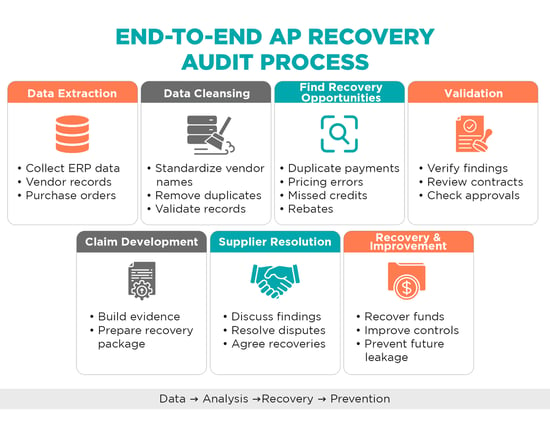
Stage 1: Data Extraction and Collection
Every recovery engagement begins with data. Before auditors can identify overpayments or missed opportunities, they need access to a complete view of historical transactions.
Typical data sources include:
- Accounts payable transaction records
- Vendor master files
- Purchase orders
- Payment registers
- Credit memos
- Goods receipt records
- Contract and pricing documentation
Many organizations assume this information is already centralized. In reality, data often resides across multiple ERP systems, business units, or acquired entities.
Consider a manufacturing company operating in several countries. One division may use SAP, while another uses Oracle. Vendor records may follow different naming conventions across systems. Before any analysis begins, these datasets must be consolidated and standardized.
Stage 2: Data Cleansing and Validation
Raw data is rarely ready for analysis. Vendor names may be inconsistent. Payment records may contain duplicates. Historical transactions may include missing fields or outdated references.
Before auditors start searching for recoverable value, the data must be cleaned and validated.
This process typically involves:
- Standardizing supplier names
- Removing duplicate records
- Correcting formatting issues
- Validating transaction completeness
- Matching related datasets
For example, one supplier might appear under several different names: Global Tech Ltd., Global Technologies Limited, G-Tech Ltd. To a system, these may appear to be separate vendors. To an auditor, they represent the same supplier relationship. Without proper cleansing, important recovery opportunities can remain hidden.
Stage 3: Recovery Opportunity Identification
Once the data is prepared, the real investigation begins. This is the stage where auditors analyze transactions and look for patterns that indicate leakage. A comprehensive account payable audit typically focuses on several categories.
Duplicate Payments
The most widely recognized recovery opportunity. These can occur when:
- The same invoice is processed twice
- Similar invoice numbers bypass controls
- Multiple vendor records exist for the same supplier
- Manual and automated processes overlap
Pricing Discrepancies
Invoices are compared against agreed pricing terms. Auditors determine whether suppliers billed according to negotiated rates and contractual commitments.
Missed Credits
Vendor credits are often issued but never applied. In large organizations, these credits can remain outstanding for years without attracting attention.
Rebate and Discount Opportunities
Many supplier agreements include volume rebates, promotional funding, or early-payment discounts. A recovery review helps identify whether these benefits were earned but never claimed.
Stage 4: Validation and Root Cause Analysis
Not every exception becomes a recovery. Once potential findings are identified, they must be validated carefully. This is where experienced auditors separate genuine opportunities from false positives.
For example, an invoice may appear to be duplicated at first glance. A deeper review may reveal that one payment covered additional services not reflected in the invoice description.
Validation typically includes:
- Reviewing supporting documentation
- Confirming contract terms
- Examining approval workflows
- Verifying payment histories
- Consulting internal stakeholders
At the same time, auditors investigate why the issue occurred. Was it a system limitation? A process failure? A vendor billing issue? Understanding the root cause is critical because recovery without prevention creates a cycle of recurring errors.
Stage 5: Recovery Claim Development
Once findings have been validated, the next step is preparing recovery claims. This stage requires evidence. Suppliers are far more likely to cooperate when presented with clear documentation that supports the claim.
A recovery package may include:
- Invoice copies
- Payment records
- Contract references
- Credit calculations
- Supporting transaction histories
The goal is to create a fact-based case that demonstrates exactly why money is owed. Well-documented claims typically move through the recovery process faster and encounter fewer disputes.
Stage 6: Supplier Engagement and Dispute Resolution
This is often the most sensitive stage of an account payable recovery audit. Recovering funds requires communication with suppliers. Many organizations worry that recovery efforts will damage important vendor relationships.
In practice, professional recovery programs focus on collaboration rather than confrontation. Most disputes fall into three categories:
Documentation Disputes
The supplier requests additional supporting evidence before acknowledging the claim.
Contract Interpretation Disputes
Both parties interpret contract language differently. These situations often require procurement and legal teams to become involved.
Transaction Disputes
The supplier believes the charge was valid and challenges the recovery request. Successful recovery teams approach these discussions with transparency and documentation.
Stage 7: Recovery and Process Improvement
The final stage is where organizations realize value.
Validated claims are recovered through:
- Refund payments
- Credit memos
- Future invoice offsets
- Contract adjustments
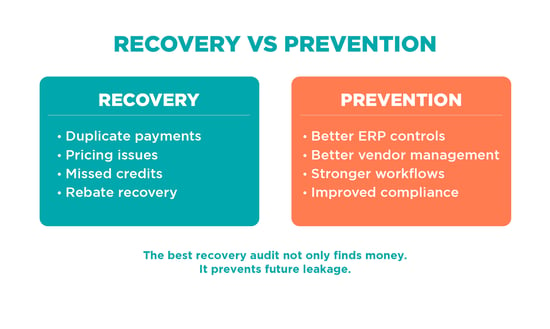
However, the most mature organizations view recovery as only part of the outcome. The bigger opportunity lies in process improvement. Every finding provides insight into how errors occurred and how they can be prevented.
Common improvements include:
- Strengthening vendor master controls
- Improving invoice matching rules
- Updating ERP configurations
- Enhancing approval workflows
- Increasing contract visibility
Conclusion
A successful account payable recovery audit is much more than a search for duplicate payments. It is a structured process that moves from data extraction and validation to recovery and long-term process improvement.
Organizations that approach recovery strategically gain more than recovered dollars. They gain visibility into operational weaknesses, stronger supplier accountability, and better control over future spend. In today's complex AP environment, those benefits often deliver value long after the recovery engagement has ended.
Every invoice tells a story. The question is whether your organization has the visibility to uncover the hidden risks and recovery opportunities within that data. Discover Dollar combines advanced AI, deep audit expertise, and proven recovery methodologies to help organizations identify leakage, recover lost value, and strengthen financial controls. If you're ready to see what your accounts payable data may be hiding, our team is ready to help.