








The majority of companies invest a lot of time and effort in negotiating contracts with suppliers. Pricing structures are meticulously examined, as are rebates and discounts, and are discussed in detail while service standards are outlined. Each provision is designed to safeguard the interests of the business's financials. The issue begins once the contract has been completed.
As transactions pass through accounts payable, procurement, and finance systems, it becomes more difficult to determine if suppliers are billing in accordance with the agreed-upon conditions. Price changes may not reflect correctly. Credits might not be claimed. Changes to contracts could not get to the teams accountable for processing invoices.
In time, these tiny gaps could lead to substantial financial leaks. This is the reason why more companies are relying on contract compliance audit services. The purpose isn't just to retrieve money that has gone missing. The objective is to improve the visibility of the execution of contracts, improve controls, and make sure that negotiated value is effective.
If a company is partnering with an AI-powered audit service, the first 90 days usually provide opportunities at a much quicker rate than traditional auditing methods. Knowing what happens in this time frame helps finance managers establish realistic expectations and evaluate the success of their efforts effectively.
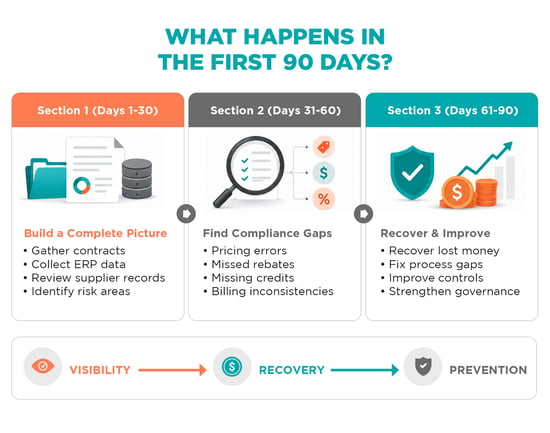
Days 1–30: Building a Complete Picture
The first month is focused on understanding the nature of contracts. Most organizations have contract-related data distributed across several systems. Contracts can be stored on the lifecycle management platform for contracts. One ERP processes invoices.
Supplier communications are often stored in shared email archives or drives. The information is important, but it's rarely linked. Before any significant analysis can be conducted, the data sources have to be linked.
In this phase, an audit team usually looks at:
- Contract repository
- ERP transaction records
- Supplier master data
- Purchase orders
- Pay history records from the past
- Information on rebates and credit
The aim is to discover the process of contract negotiation from implementation. This process often uncovers problems that went unnoticed for many years.
Certain suppliers might have multiple records in the system. Certain amendments to contracts may not be reflected in the workflows for billing. In some instances, no clearly designated owner is responsible for ensuring compliance.
While these results may not immediately lead to recovery, they are vital. They show the areas where risk is concentrated. At the beginning of the month, many businesses have a much better grasp of the contract's structure and areas that need more analysis.
Days 31–60: Identifying Compliance Gaps and Leakage
After the data foundation is established, the focus shifts to analysis. This is when AI starts to improve noticeably. Traditional audits usually depend on sampling and predefined guidelines.
Modern technology allows for the analysis of entire databases and uncover patterns that are difficult for manual reviewers to discover. The review goes beyond simple matching of invoices.
The analysis instead is focused on issues such as:
- Are there suppliers who charge rates that are different from the contract's terms?
- Have all rebates that are eligible been received?
- Are amendments to contracts accurately reflected in invoices?
- Are promotional allowances utilized in a proper manner?
- Are terms of pricing based on performance being implemented?
The objective is not to find isolated mistakes. The aim is to identify the patterns that are common to leaks across supplier relationships.
Many common problems typically arise during this time:
Pricing Variances
Suppliers can be charged rates that are higher than the amount in the contract. These differences can last for months since they aren't significant enough to warrant immediate attention.
Missed Credits and Rebates
Credits that ought to be issued have not been. Rebates earned are often not used or allocated correctly.
Contract Interpretation Issues
Different teams might interpret the contract language in different ways. This means that invoices are processed in a way that isn't in accordance with the original contract.
Billing Inconsistencies
Recurring invoice patterns may reveal problems with compliance that affect several transactions that span a longer time.
Days 61–90: Recovery and Process Improvement
The final phase is focused on transforming findings into quantifiable results. In this stage, an audit group has identified any potential violations of compliance and confirmed the most important findings. It is now time to determine what the implications of those findings are for recovery and process improvement.
A reputable audit firm that is reputable doesn't just give an audit report and then walk away. Instead, they aid businesses in prioritizing their actions based on the financial impact, relationships with suppliers, and operational and business complexity.
In this phase, the teams tend to be focused on:
- Rectifying opportunities for recovery
- Supporting supplier discussions
- Prioritizing high-value findings
- Recognizing the root causes
- Establishing monitoring mechanisms
The aim is to recoup value and reduce the risk of leakage in the future. Many organizations see gains in three areas.
Financial Recovery
Overcharges, credit card errors, rebate discrepancies, and mistakes in billing are incorporated into the process of recovery.
Stronger Processes
The audit reveals the weaknesses in controls, workflows, and system configurations, which caused compliance issues to arise.
Better Governance
Leaders gain visibility into supplier performance and contract execution, which previously was not available. These enhancements often result in added value that goes beyond the initial recovery opportunities.
What Early Success Really Looks Like
One of the most common misconceptions concerning contract compliance audits is that the success of audits should be measured solely in terms of recovering dollars.
It is crucial to recover; however, it's not the only indication of the success of your engagement. The best programs offer advantages that last well beyond the initial review.
Early indicators of success usually are:
- Better visibility into contract performance
- Quicker identification of billing issues
- Increased accountability of suppliers
- Reduction of manual review time
- Improved collaboration between finance and procurement
- Greater trust in the financial report
Conclusion
The majority of revenue leaks don't result from major errors. It's caused by tiny violations that go unnoticed over thousands of transactions, as well as many supplier relations. In time, those gaps could lower margins and decrease the value of contracts that companies have worked to achieve.
A carefully designed program for contract compliance audits helps to close the gaps. In the first 90 days, they give the information needed to know the areas where there are risks, determine the value that can be recovered, and build the processes to ensure long-term compliance. In addition, they lay the basis for a proactive plan which focuses on prevention, not correction.
Every contract has the potential to safeguard margins, recover value, and increase accountability. The problem is ensuring that those opportunities don't get lost in the midst of negotiation and implementation. Discover Dollar combines sophisticated AI and deep audit knowledge to assist organizations in identifying the hidden leaks verify the compliance of their financial controls. If you're interested in understanding the potential cost of your contracts costing you now, now is the best time to discuss the issue.