







The finance departments of enterprises are increasingly under pressure to go beyond processing invoices in a timely manner. They need to improve working capital, strengthen controls, reduce leakage, and deliver greater financial transparency while managing growing transaction volumes. As a result, many organizations are re-evaluating their accounts payable solutions to ensure they support both operational efficiency and strategic financial goals.
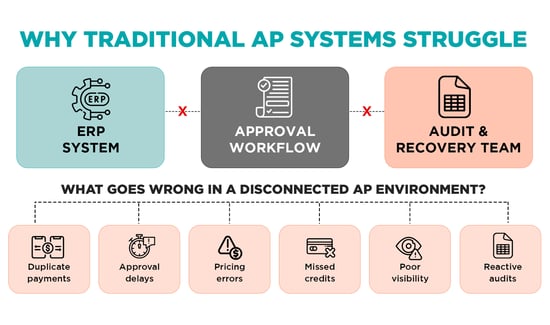
Large companies often operate with disconnected systems. The ERP handles transactions. Workflow platforms manage approvals. Audit teams conduct separate reviews. Recovery efforts happen periodically and often only after financial leakage has already occurred. This creates a fragmented environment where data exists across multiple systems, but true visibility remains limited.
Why Traditional AP Technology Stacks Struggle at Scale
The majority of enterprise AP environments have evolved, rather than being planned strategically. An ERP was created to handle financial transactions. Later, a workflow-based platform was added to allow approvals.
Systems for managing documents were developed to help store invoices. Audit teams relied on distinct review tools as well as spreadsheet-based analysis. Each system was able to address the immediate operational needs. Together, however, they have created silos.
In the case of moderate volumes of transactions, the fragmentation could be easily manageable. However, large-scale companies that process hundreds of thousands or millions of invoices per year are confronted with a totally different set of challenges.
Common challenges start to appear:
- Payments that are duplicated
- Contract pricing discrepancies
- Incomplete rebates and credits
- Approval delays
- Insufficient cross-system visibility
- Recovery cycles and reactive audits
The problem isn't always inadequate control. It's disconnected.
This is where businesses are shifting towards integrated accounts payable solutions that combine processing, monitoring, intelligence, and control.
What Does an AI-First AP Stack Actually Mean?
The expression "AI-first" is often misunderstood. It doesn't require replacing finance teams or automating decision-making in the absence of supervision.
An AI-first AP environment employs intelligence to improve human judgment and examine financial activities.
Traditional AP systems are focused on processing transactions. AI-first systems concentrate on understanding transactions. That distinction matters.
Instead of simply recording activities, intelligent systems recognize:
- Payment irregularities
- Vendor behavior patterns
- Pricing deviations
- Contract mismatches
- Bottlenecks for approval
- Risks of leakage that are emerging
This changes AP from a processing centre to a financial control function. The underlying principle of this transformation is in the modern audit compliance software, which operates across several systems and continuously analyzes financial information.
The Three-Layer Blueprint for an AI-First AP Stack
The creation of a highly-performing AP environment is more than just purchasing software. It requires an architectural approach.
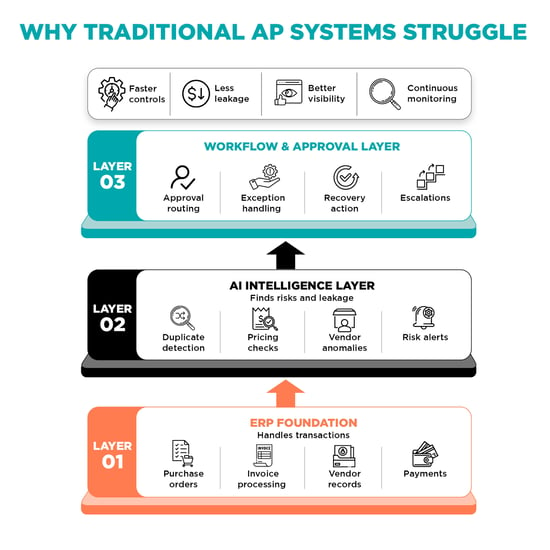
The majority of successful businesses use a three-layer structure.
Layer One: ERP as the Transaction Foundation
The ERP is still the core of operations.
Systems such as SAP, Oracle, and Microsoft Dynamics continue to manage:
- Purchase orders
- Invoice processing
- Vendor records
- Payment execution
- Financial reporting
This layer guarantees the integrity of transactions.
However, ERP systems were not created to serve as intelligence engines.
They are able to follow rules efficiently, but struggle with complex abnormality detection, fuzzy matches, and behavioral analyses.
This is the reason ERP by itself isn't enough to prevent financial leakage.
It is a foundation, but not the entire solution.
Layer Two: AI Recovery and Intelligence Layer
In the next layer, transformation occurs.
AI-powered monitoring and recovery platforms are above the transactional systems and monitor activities continuously.
This layer of intelligence improves accounts payable solutions by looking at more than just basic validation rules.
Do not ask:
"Does this invoice match predefined fields? "
The system is asking:
"Does this transaction make sense within historical, contractual, and behavioral patterns? "
This feature allows the detection of:
- Duplicate invoices
- Vendor master inconsistencies
- Price change
- Inaccurate deductions
- Unclaimed credits
- Payment irregularities
This is the point where the latest audit compliance software is essential.
Instead of relying on regular checks, AI continuously monitors 100 percent of transactions. It also identifies the risk indicators in a timely manner.
The value extends far beyond the recovery.
It helps prevent.
Layer Three: Workflow and Approval Orchestration
Even the most sophisticated analytics require operationalization.
This is what happens with workflow platforms.
Third layer coordinates are:
- Approval of routing
- Exception handling
- Escalation workflows
- Dispute management
- Validation of recovery
Without workflow orchestration, the insights remain in dashboards. An apparent price discrepancy detected by AI needs to be addressed.
A duplicate payment still requires investigation. A vendor credit still requires recovery coordination. Workflow platforms help to translate intelligence into tangible results. This is the reason that companies often undervalue how important integration is.
The delay in resolution caused by disconnected approvals could be a result of delays and reduce the financial controls. A well-integrated workflow can help you be accountable.
Why Integration Is the Real Competitive Advantage
Many finance professionals look at AP technology in isolation. This approach is a missed potential.
The most value does not result from tools that are standalone. It is a result of interoperability.
The AI-first approach operates because ERP systems, as well as analytics engines and workflow platforms, share information continually.
Consider a typical scenario.
An invoice is sent by a supplier that has a slightly higher price than the agreed-upon rates
A typical environment could take the invoice into account and identify the issue in an audit cycle to come.
A system that is integrated behaves differently.
The ERP tracks the transaction.
AI analyzes it in relation to the history of contracts and the behavior of suppliers.
The workflow platform will automatically route the exception to the appropriate platform. The finance department reviews and fixes the issue prior to the payment, or within a short time afterward. This allows for more rapid corrections, better controls, and less exposed leakage.
The audit compliance software is becoming increasingly based on this networked model since enterprises require visibility that is at the same speed as transactions.
AI Changes Auditing from Reactive To Predictive
In the past, AP recovery was retrospective. Auditors looked at the history of transactions. Errors were found after the incident. The issue in this model is the timing.
If an error lasts longer, it becomes more difficult to correct. AI fundamentally alters this equation.
As opposed to waiting until audits are scheduled, intelligent systems can detect patterns on a regular basis.
This includes:
- Vendor billing anomalies
- Multiple approval exemptions
- Recurring pricing deviations
- Control weaknesses are emerging
This predictive capability is changing how companies think about audit compliance software.
It's no longer just an instrument for Auditing. It is now an integral part of risk management for enterprises. Finance teams have early visibility into problems before they develop into a significant risk. This is an important strategic benefit.
What Finance Leaders Should Evaluate Before Building the Stack
The selection of technology should start with the architecture, not the features.
Before deciding to invest, business leaders must consider:
- Do systems work in our ERP environment?
- Does the platform keep track of all transactions?
- How fast can insights trigger workflows?
- Does the system have the ability to scale across business units and regions?
- Does it help with the process of recovery as well as prevention?
- What is the required internal effort to keep it running?
The best accounts payable solutions are more than just a way to automate invoices. They build a connected system that combines action, intelligence and governance, which are integrated.
Final Words
High-volume AP environments cannot depend on a splintered system and delayed audits for a long time. The complexity of financial transactions is increasing, and so are the risks associated with unconnected processes.
A first-of-its-kind AI AP stack isn't just an upgrade to technology. It's a complete overhaul of how finance teams control visibility, monitoring, and recovery. Through the integration of ERP platforms with intelligent analytics and workflow tools, organizations can go past reactive correction and towards continual financial safeguarding. The future of AP lies with companies that connect their systems and let the intelligence of their systems guide their choices.
If your AP environment is still dependent on outdated tools and regular audits, you could have untapped value in your systems. Discover Dollar aids large-scale enterprises in building smart, AI-powered finance systems that increase visibility, improve controls, and speed recovery.
Get in touch with us to discover what an intelligent AP stack might reveal to benefit your business.
Frequently Asked Questions
An AI-first stack combines ERP systems, workflow tools, recovery engines, and audit compliance software to automate AP monitoring and decision-making. Rather than relying on isolated tools, Discover Dollar promotes an integrated ecosystem that continuously identifies risk, improves visibility, and strengthens financial controls across enterprise operations.