








There's a conversation that happens in boardrooms more often than most finance leaders would like to admit. The CFO asks why the accounts payable function, despite running on a tier-one ERP, staffed by experienced professionals, is still hemorrhaging money. The answer, more often than not, traces back to a single blind spot: the assumption that having good systems means having clean books.
It doesn't, and this is why accounts payable audits exist.
And more importantly, it's why understanding accounts payable audit cost — not just as an expense line but as a strategic lever — separates the finance teams that win from the ones that simply report.
What Does an AP Audit Actually Cost?
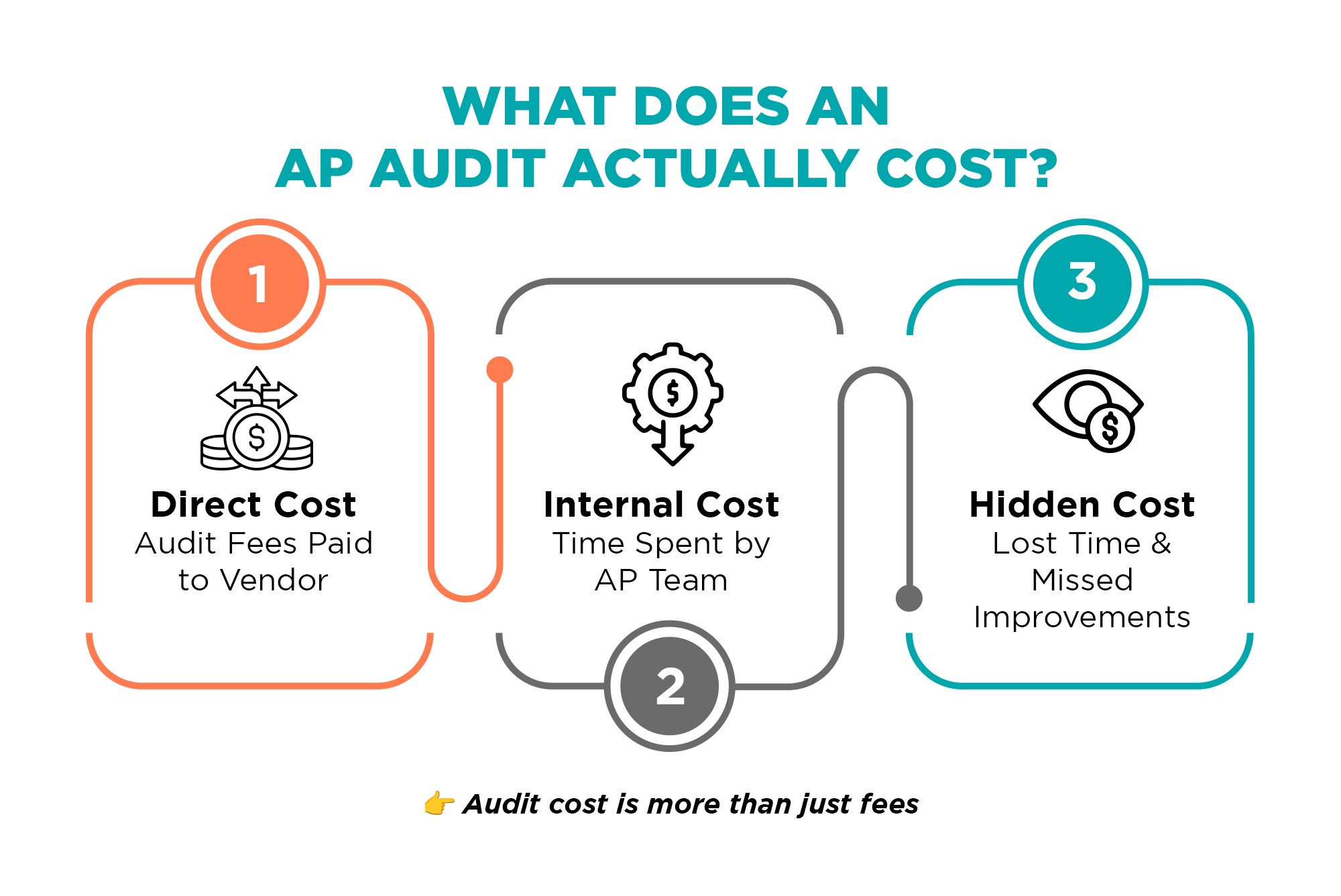
The accounts payable audit cost is made up of several distinct layers, and collapsing them into a single number misses the point entirely.
The first layer is direct spend — fees paid to an audit firm or technology vendor to conduct the review. For a traditional manual audit, this typically runs anywhere from $50,000 to several hundred thousand dollars, depending on the volume of transactions and the breadth of vendor relationships being reviewed. The audit firm will assign analysts who manually sample invoices, cross-reference purchase orders, and flag anomalies.
The second layer is internal resource cost. Your AP team doesn't stop working while an audit happens. They spend weeks pulling data, responding to queries, reconciling findings, and coordinating with vendors. For a Fortune 500 organization processing hundreds of thousands of invoices annually, this internal effort can easily run into tens of thousands of hours — often invisible on the cost ledger but very real in terms of productivity drain.
The third layer is opportunity cost. Every week spent in a reactive audit cycle is a week not spent on process redesign, vendor negotiation, or forward-looking financial controls. Manual audits are inherently backward-looking — they tell you what went wrong, not what's about to go wrong. And then there's the cost of what the audit misses. Traditional sampling-based approaches review five to ten percent of transactions. The rest — the 90-plus percent where errors may be quietly accumulating — go unexamined until the next audit cycle, if ever.
Traditional vs. AI-Driven AP Audits: A Meaningful Distinction
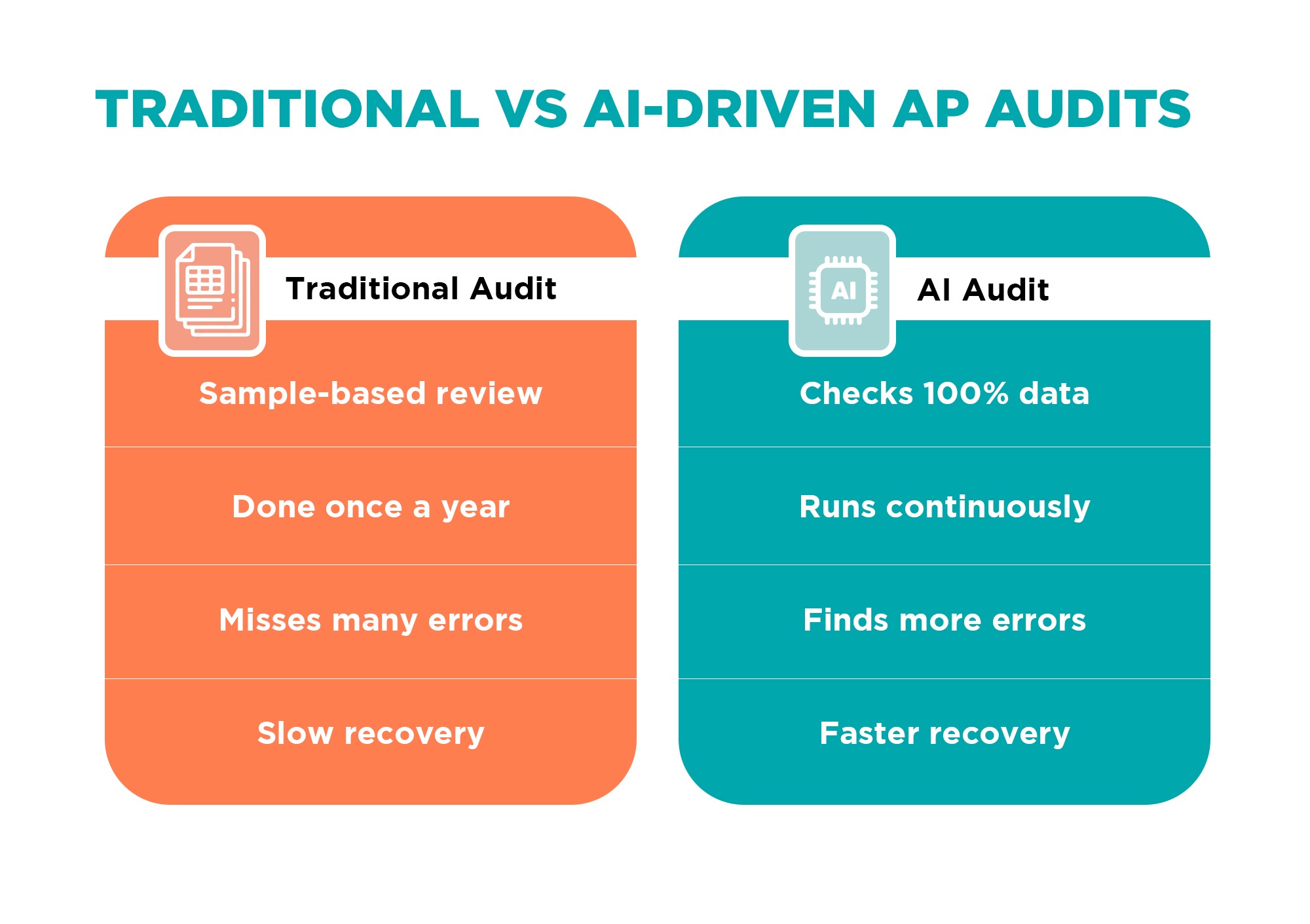
The structural difference between legacy audit approaches and AI-powered alternatives is not just speed — it's coverage, accuracy, and compounding value. A traditional AP audit is a periodic exercise. A team reviews a sample, produces a report, and the organization corrects the flagged issues. Until the next audit, the process continues largely unchanged. Errors introduced six months after the audit closes won't surface until the next engagement.
An AI-driven audit, by contrast, runs continuously. Machine learning models analyze 100 percent of transactions in near real-time, scanning for pricing discrepancies, duplicate payments, missed rebates, early payment errors, and contract compliance gaps simultaneously. The accounts payable audit cost associated with this model is fundamentally different — it's more of a recurring platform investment that scales with spend, not with the number of auditors deployed.
The practical implication is significant. Companies working with AI-powered audit platforms consistently find that the volume of recoverable errors identified is three to five times higher than what traditional audits surface. Not because the errors are new, but because sampling simply wasn't catching them.
ROI Benchmarks Worth Knowing
Organizations that have shifted to continuous, AI-led AP audit programs report some consistent outcomes. For every dollar invested in accounts payable audit cost under this model, the average return is four times or more — a figure that holds across industries, including retail, healthcare, CPG, and manufacturing.
More concretely, a company processing $1 billion in annual AP spend can expect to lose between $1 million and $5 million to errors, overpayments, and process gaps even with strong internal controls. That's not a failure of the finance team — it's a structural reality of operating at scale across hundreds of vendors, multiple systems, and millions of discrete transactions.
The recovery timeline matters too. AI-driven programs typically deliver initial findings within four to eight weeks of engagement. That's not a trailing indicator; it's recoverable cash flowing back to the P&L within the same fiscal quarter in many cases.
Reclassifying the Audit from Cost to Asset
The most sophisticated finance leaders have stopped thinking about accounts payable audit cost as an expense that must be minimized. They've reclassified it as an investment with a measurable, predictable return.
This shift in mindset has practical consequences. Audit findings feed process improvement roadmaps. Vendor relationship data from audits informs sourcing strategy. Patterns in payment errors reveal gaps in ERP configuration or policy enforcement that no internal control checklist would ever catch.
The audit, done right, is not just a cleanup exercise. It's an intelligence function, one that continuously surfaces where value is leaking and why. For finance teams that have historically treated the AP audit as a cost of doing business, the real question is this:
Final Words
Audit costs for accounts payable are frequently misinterpreted because it is viewed as a separate line item to be controlled instead of a lever to improve. However, leading finance teams view the issue in a different way. They consider cost as a factor in the recovery and coverage of their business, as well as longer-term improvement in the process. This is where the shift takes place, from expense to benefit.
As audits progress from regular inspections to ongoing intelligence, they do more than just collect funds; they also prevent losses, improve controls, and boost financial decision-making across the entire finance function. The biggest risk isn't in the expense of an audit. It's the cost of not having awareness.
If your current approach to auditing produces reports but doesn't provide any real financial benefit, it's time to reconsider the process. Discover Dollar can help businesses transform accounts payable audits into a quantifiable profit center by using the power of AI to drive recovery based on performance. Make a quick evaluation and determine the value your AP function is not delivering. Talk to our experts today.
Frequently Asked Questions
Accounts payable audit cost depends on transaction volume, number of ERP systems, vendor complexity, and audit scope. However, the pricing model matters most. Discover Dollar’s success-fee approach eliminates upfront cost and ties fees directly to recovered value, making cost a function of performance rather than fixed expenditure.