








In larger organizations, supplier payments hardly involve an easy exchange of money and invoices. Several transactions move across the accounts payable systems each month. In the process, credit notes, overpayments, price corrections, and other supplier credits can be missed.
Undoubtedly, these amounts belong to the organization. However, it has been observed that such credits may go unnoticed for several months. This is where vendor statement reconciliation comes into the picture. Through the reconciliation, it is possible to discover the lost credits and retrieve the money.
Define Vendor Reconciliation Statement
This reconciliation is the comparison of vendor statements provided by vendors with the internal accounts payable of the organization. The vendor statement will have particulars such as invoicing amount, payment amount, credit notes, balances, and other account adjustments. The purpose of this activity is to reconcile records with both parties so that all transactions are properly accounted for.
For instance, the vendor may send a credit note for 2 lakhs based on the product return or discount. But if the credit note is not processed in the buyer's AP system, the accounts may still reflect the payable amount in the ledger. This can lead to overpayment if the mismatch is not corrected, as the organization may end up paying more than what it owes.
Vendors can also have credits in their systems for overpayment in previous transactions. Reconciliation can help to detect such mismatch to identify the organization's entitlement to a refund or credit.
Why Unclaimed Credits Remain in Supplier Accounts
Even organizations with good AP procedures and ERP systems can fail to recognize unclaimed credits from their suppliers. However, the main reason for this is their lack of unified accounts. Below are some possible causes:
1. Unrecorded Credit Notes
Credit notes are issued by suppliers in case of returns, damaged products, or incorrectly priced products. However, sometimes these documents are not sent to the right AP department. In such cases, the supplier's account shows a credit balance unrecognized by the enterprise.
2. Duplicate Payments
Duplicate invoices and manual processing errors lead to suppliers receiving more than the required amount. An overpayment would be entered as available credits in the supplier's accounts. The lack of reconciliation might lead to these amounts remaining unclaimed.
3. Missed Contractual Discounts and Rebates
Sometimes supplier agreements involve promotional allowances, volume-based discounts, and other commercial benefits. If the invoices do not reflect these terms, organizations might miss the contractual credits they are entitled to.
4. Data Discrepancies across ERP Systems
Large companies are known to run many ERP systems in different subsidiary companies, locations, and business units. Divergent vendor codes, invoice numbers, and transactional processes make it hard to get a clear idea of the outstanding balances against suppliers. A credit entry made for one vendor may not even appear on the books of another business unit having dealings with the same vendor.
5. Open Transactions from the Past
Balances may be outstanding due to lack of proper documentation, personnel turnover, or pending issues with suppliers.
Role of Vendor Statement Reconciliation for Enterprises Recovering Unclaimed Credits
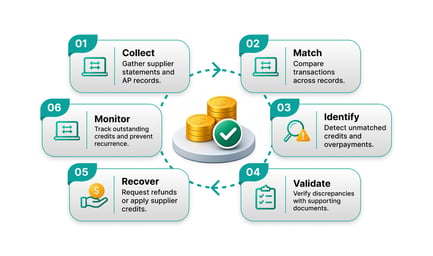
It is not just the identification of any discrepancies between the two sets of accounting records. In simple words, it is the assessment of whether the discrepancies indicate recoverable losses. Here are the steps that organizations can follow to carry out the process.
Step 1: Gather Supplier Statements and Company's AP Data
This step entails gathering all the supplier statements, invoices, payment history, credit memos, purchase orders, etc. For big companies, this information may be available across various ERP and AP solutions.
Step 2: Align Supplier Transactions With Internal Records
Every single entry in the supplier statements needs to be cross-referenced with the transaction entry in the AP ledger. The process of matching is usually done on the basis of invoice numbers, suppliers' identity, transaction dates, amounts, purchase order numbers, and payment references.
Nevertheless, simple matching may not always be sufficient because of various invoice formats, shortened references, and vendor identity variations. Data analytics can be applied in such cases to identify potential matches.
Step 3: Detect Unmatched Credits and Payment Discrepancies
After comparing the records, reconciliation teams detect transactions with further investigation. The best thing is to classify the discrepancies according to their financial value, cause, and supporting documentation.
Step 4: Validate Claims With Supporting Documents
Not all differences will be recoverable amounts. Certain differences may arise due to timing differences, pending adjustments, or transactions that have not been processed yet. Hence, businesses will need to validate claims using invoices, payment advice, supplier's credit notes, purchase orders, and contracts. This process will help to determine if there is any outstanding credit from the supplier.
Step 5: Clarify Discrepancies with Suppliers
Following validation, the AP department can engage with suppliers and seek refunds, apply credits to unsettled invoices, or settle any disputes. Documentation of the recovery process is essential, especially when working with multiple vendors and a large volume of transactions.
Step 6: Monitoring Outstanding Credits and Avoiding Recurrence
Credit recovery should not mark the end of the process. Companies also have to figure out the reasons for the credit being unclaimed. Identification of recurring discrepancies will shed light on potential issues with invoicing, vendor onboarding, payment authorization, or contract management.
Role of AI-Powered AP Recovery Audits in Strengthening Credit Recovery
Reconciliation traditionally involves spotting the differences within certain accounting periods. The process of auditing accounts payable is somewhat different since it involves analyzing past deals and finding out financial opportunities that the AP control procedures sometimes overlook.
Using analytics with the help of artificial intelligence will allow for analyzing a huge amount of transactions, comparing the records in the ERP system, detecting any abnormalities in the payment process, possible double payments, and undiscovered credits.
The following methods are how this particular approach helps enterprises:
- Analyzing suppliers' history statements and transactions
- Detecting unmatched credit notes and overpayments
- Detection of inconsistencies in several ERP systems
- Identification of the most profitable opportunities for recovery
- Minimization of routine work for verifying facts
- Observation of constant financial leakage
Final Thoughts
These unclaimed supplier credits are not just a simple issue of accounting inaccuracies. In big companies, they can be caused by overpayments, missing credit memos, and other adjustments not yet made to the suppliers' accounts. A systematized reconciliation process can help organizations detect these credits, verify their recoverability, and correct their suppliers' accounts.
By using historical transaction data analysis, discrepancy detection, and recovery verification, big companies can go beyond the simple step of invoice matching in financial management. Through the Accounts Payable Recovery Audit, Discover Dollar enables companies to detect unclaimed credits and recover overpayments.