








In many companies, an audit of accounts payable is considered a must-do procedure to detect the sources of overpayments, process flaws, and weak controls. But as financial operations become more complicated and more complex, the cost of performing these audits continues to grow.
Large corporations typically have several ERP systems, a multitude of suppliers, a variety of business units, as well as millions of transactions on invoices. The task of reviewing this amount of data manually may take a lot of time, special resources, and coordination between finance departments.
The issue is not how AP audits are beneficial. They are often able to uncover significant opportunities to recover. The more important issue is how finance managers can effectively manage audit costs for Accounts Payable while still ensuring the audit yields meaningful results for recovery. The solution lies in improving the way audits are planned, carried out, and aided by technology.
Why AP Audit Costs Increase in Enterprise Environments
AP audit expenses are not the result of a single element. They typically increase due to the complexity of payment processes.
Global organizations can process invoices using different systems after mergers, regional expansions, as well as business restructuring. Supplier records can be stored in a variety of types across various ERPs. The payment policies can differ between business units. Terms of contracts may be changed without having a full view of all procurements and AP. This can lead to additional work when conducting an audit.
Audit teams typically spend a lot of hours focusing on tasks such as:
- Cleaning and extracting transaction information
- The matching of invoices across different systems
- Studying possible alternatives
- Validating supplier details
- Investigating payment history
- Coordination with internal stakeholders
If the bulk of this work is performed manually, the cost of an audit increases before the recovery analysis is even begun.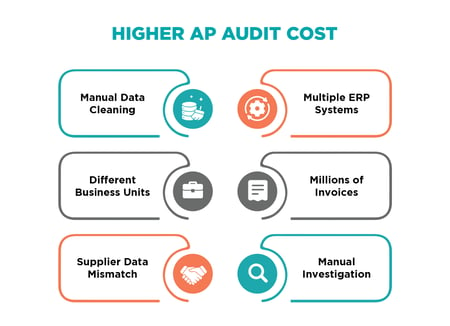
The Balance Between the Audit Cost and Recovery Value
The reduction in audit expenses does not mean reducing the scope of audits or limiting analysis. A less expensive audit that overlooks significant opportunities for recovery can create a false impression of effectiveness. In the same way, a meticulous audit that demands a lot of manual work may not provide the desired ROI.
Five Ways Finance Teams Can Reduce AP Audit Costs
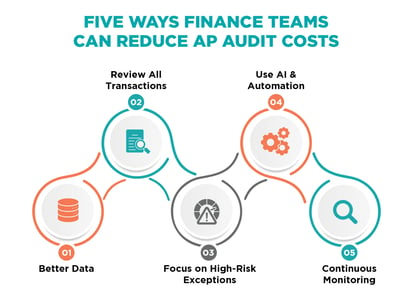
1. Improve Data Readiness Before the Audit Begins
A significant portion of auditing efforts is used to prepare data, rather than the process of analyzing it. Before an audit's start, teams might need to consolidate the payment file, standardize information about suppliers, and eliminate inconsistencies among systems.
A structured data environment could significantly make this work easier. Finance teams must prioritise:
- Standardized supplier master data
- The same invoice fields are used across all systems
- Improved connection and better integration of AP with procurement and AP data
- Transparency of transaction records
If auditors have clearer and more complete information, they are able to be more productive in identifying problems instead of writing the information.
2. Move Beyond Sample-Based Reviews
Traditional AP audits usually depend on sampling since the manual review of every transaction isn't feasible. However, sampling could result in opportunities for recovery that are not discovered.
The possibility of a double payment, pricing mistake, or an overpayment might appear to be insignificant for a single transaction. Still, it becomes apparent after millions of transactions are examined.
For instance, a vendor could submit slightly different invoice numbers across different business units. Each invoice might appear to be valid when viewed individually. An analysis that is more extensive across ERP systems could uncover that the same quantity of invoice, the same supplier, and the same payment method were used repeatedly.
3. Use Technology to Prioritize High-Value Exceptions
Not every payment exception requires the same level of scrutiny. One of the main factors that drives AP audit expenses is spending equal time analyzing high-value risk and low-impact exceptions.
The technology available to finance teams can help them to prioritize their findings by analyzing various factors, including:
- The frequency of payment
- Supplier history
- Similarities in invoices
- Contract modifications
- Duplicate indicators
- Pricing inconsistencies
Instead of analyzing the thousands of possible exceptions by hand, audit teams can concentrate attention on the cases that have a greater chance of recovery.
4. Reduce Manual Investigation Effort
Manual review remains among the most costly aspects in AP audits. Auditors may have to check invoices against dates for payment, look over the records of suppliers, and converse with various departments to determine the existence of an issue.
Modern audit methods employ automation to perform routine analysis tasks. For instance, AI-based analysis can detect patterns in large data sets, for example:
- Similar invoice amounts paid multiple times
- Duplicate suppliers under different records
- Unusual timing of payment
- Variations in pricing based on transactions from the past
It is not designed to substitute the expertise of finance professionals. Instead, it allows auditors to spend more time evaluating business concerns and spend less time trying to find them.
5. Build Continuous Monitoring Instead of Periodic Audits
Many companies carry out AP audits once or twice a year. Once issues have been discovered, opportunities for recovery may be difficult to identify. Continuous monitoring is a new strategy.
Rather than waiting until an audit date, finance teams frequently review the payment process and spot emerging risk sooner. This strategy can help organizations:
- Verify errors before the date of transaction
- Enhance AP controls
- Limit leakage in the future
- Maintain stronger audit readiness
For large businesses, continuous visibility can cut down the need for costly, time-consuming review.
Building a More Efficient AP Audit Strategy
Reduced AP audit costs require a shift away from labour-intensive audits to data-driven analysis. Finance teams can improve results by improving the quality of their data, increasing transparency for transactions, and prioritizing risks with high value, making use of technology to aid in auditing decision-making.
Discover Dollar aids finance departments of enterprises in analysing complex payment environments, spotting potential recovery opportunities that are not being utilized as well as improving AP visibility by using methods of auditing that are based on data. Combining technology with knowledge of finance, businesses can cut down on auditing while also preserving recovery value.