








Imagine managing a business where hundreds or even thousands of transactions occur daily. With that much activity, it's not uncommon for overpayments, duplicate invoices, or unclaimed vendor credits to go unnoticed. That's where Accounts Payable Recovery Audit steps in.
By conducting a thorough review of your payment processes, AP recovery audits can uncover hidden discrepancies, helping your business recover funds and tighten its financial controls. With the advent of AI, leading AP recovery audit providers now leverage advanced technologies to automate the recovery audit process, significantly reducing the time and effort required compared to traditional manual methods. This shift increases accuracy and also accelerates the identification of payment issues.
But adopting these audits isn't just about spotting errors—it's about creating a strategy for how to implement Accounts Payable Recovery Audit effectively and maximizing their impact. Let's explore how to successfully adopt and implement AP recovery audits while avoiding common pitfalls along the way.
How to Implement Accounts Payable Recovery Audit?
Implementing an Accounts Payable Recovery Audit successfully requires a clear and actionable plan. Here's a step-by-step guide to ensure you're on the right track:
1.Data Collection
Start by gathering all relevant financial data, including Accounts Payable records, Vendor Master data, invoices, and other related documents. This forms the audit's foundation, ensuring everything is noticed when identifying potential issues.
2.Claim Identification
Using advanced algorithms or specialized tools, analyze the data to uncover potential claims. These could range from duplicate payments, missed discounts, and erroneous payments to vendor overcharges. Think of it as a safety net to catch financial discrepancies that often slip through the cracks in daily operations.
3.Collaborative Review
Once potential claims are identified, it's crucial to review them with your internal finance and procurement teams. This collaboration helps ensure the accuracy of findings and aligns the teams to take prompt and effective corrective actions.
4.Auditing and Recovery
Once the claims are confirmed, it's time to reach out to the vendors to clarify discrepancies and recover the funds. This is where the process directly impacts your bottom line, as recovered payments flow back into your accounts. Patience and persistence in this step are key to maximizing recovery.
5.Monitoring and Prevention
An effective audit doesn't stop at recovering lost funds. Implement ongoing monitoring systems to prevent future errors. This can include regular reviews, automated checks, and empowering your team with the tools they need to keep your payment processes airtight moving forward.
6.Continuous Improvement and Support
As your audit process evolves, it's essential to provide continuous training and updates to your team. By keeping everyone informed about the latest best practices, you can ensure the long-term success of your Accounts Payable processes and minimize future financial leakages.
Best Practices for how to implement Accounts Payable Recovery Audit
Successfully implementing an Accounts Payable Recovery Audit requires more than just reviewing invoices—it's about creating a system that prevents future errors while recovering lost funds. Here are the best practices that can ensure an effective AP recovery audit process:
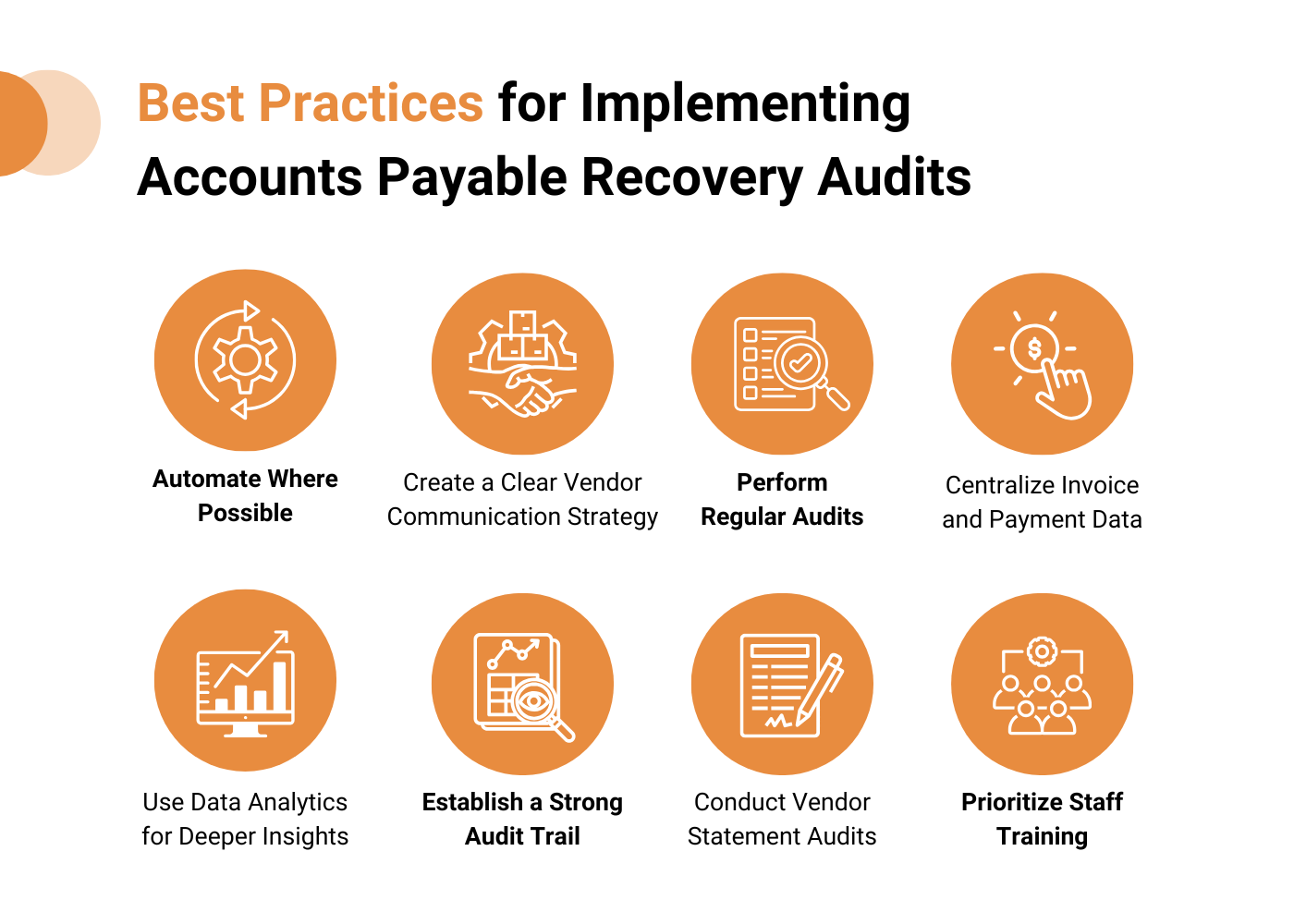
1. Automate Where Possible
One of the easiest ways to reduce human error is through automation. By automating the AP process, you can minimize the risk of manual data entry mistakes, duplicates, and missed payments. Automation can also streamline auditing by flagging unusual payments, duplicate invoices, or unmatched purchase orders (POs) and invoices.
2. Create a Clear Vendor Communication Strategy
Miscommunication with vendors can lead to overpayments, unclaimed credits, or duplicate invoices. A well-defined communication strategy ensures that expectations are clear regarding payment terms, discounts, and credits.
3. Perform Regular Audits
Routine AP audits should be built into your financial processes. Waiting until errors accumulate can lead to larger financial risks. Conducting regular, small-scale audits helps catch discrepancies early and prevents them from becoming major liabilities.
4. Centralize Invoice and Payment Data
Many discrepancies occur because data is siloed across departments, making it harder to identify duplicates or erroneous payments. Centralizing invoice and payment data in a single system ensures that your AP team has complete visibility into all transactions.
5. Use Data Analytics for Deeper Insights
Data analytics can help you go beyond surface-level errors to identify trends and deeper issues within your AP processes. With data analysis tools, you can identify patterns of recurring errors, spot areas where most discrepancies arise, and target specific vendors or categories for further review.
6. Establish a Strong Audit Trail
Maintaining a comprehensive audit trail is essential for compliance and error tracking. A clear trail helps auditors easily trace transactions, identify the root cause of discrepancies, and ensure that corrective actions are taken.
7. Conduct Vendor Statement Audits
In addition to reviewing internal records, conducting vendor statement audits is crucial for capturing discrepancies like missed credits, duplicate payments, or unclaimed funds. By comparing your internal payment records with vendor statements, you can identify inconsistencies.
8. Prioritize Staff Training
Even with automation, data analytics, and centralized systems, your team remains a crucial part of the AP process. Regularly training your staff on the latest AP practices, technologies, and compliance standards ensures they remain vigilant against errors.
Common Pitfalls to Avoid in Accounts Payable Recovery Audit
Successfully navigating an Accounts Payable recovery audit involves more than just implementing best practices; it also requires avoiding common pitfalls that can undermine the effectiveness of the audit process. Here's a look at some of the most frequent mistakes businesses make and how to steer clear of them:
1. Neglecting to Standardize Processes
A lack of standardized processes can lead to inconsistent audits, missed discrepancies, and inefficient recovery efforts. Without a uniform approach, different departments or team members may handle AP processes differently, leading to gaps in error detection.
Example: A retail company did not standardize its invoice matching process across different regions, leading to inconsistent handling of discrepancies. This oversight resulted in missed recoveries amounting to $60,000.
2. Ignoring Small Discrepancies
Small discrepancies are often overlooked in favor of focusing on larger, more obvious issues. However, these minor errors can accumulate over time and lead to significant financial losses if not addressed promptly.
Example: A healthcare provider ignored small discrepancies in invoice amounts that seemed minor individually but accumulated to over $15,000 over a year. A thorough audit later revealed these missed amounts.
3. Overlooking Historical Data
Failing to consider historical data can result in missed patterns of recurring errors or discrepancies. Historical data is crucial for identifying trends and preventing future mistakes.
Example: A manufacturing firm only focused on current transactions and ignored historical data. This oversight caused them to miss recurring issues with specific vendors, leading to a loss of $100,000 in recoverable overpayments.
4. Inadequate Vendor Communication
Poor communication with vendors can lead to misunderstandings, unresolved discrepancies, and missed recovery opportunities. Effective communication is essential for clarifying terms, resolving disputes, and ensuring that all parties are on the same page.
Example: An e-commerce company had frequent disputes with vendors over missed discounts due to poor communication. As a result, they missed out on $25,000 in recoverable discounts.
5. Failing to Update Systems and Processes
Outdated systems and processes can lead to inefficiencies and errors in the AP recovery audit process. Regular updates are necessary to keep pace with changes in technology, regulatory requirements, and business practices.
Example: An oil and gas company relied on outdated manual processes for invoice matching, leading to numerous errors and missed recoveries totaling $45,000. Upgrading to an automated system could have prevented these issues.
6. Not Leveraging Technology
Failing to leverage available technology for AP recovery audits can result in missed efficiencies and inaccuracies. Technology can automate processes, analyze data, and identify discrepancies more effectively than manual methods.
Example: A CPG company did not use advanced data analytics tools for their audits, missing patterns in payment discrepancies that amounted to $35,000 in recoverable funds.
7. Inadequate Documentation and Record Keeping
Proper documentation and record-keeping are essential for effective audits. Inadequate records can hinder the recovery process and make it difficult to trace discrepancies or validate claims.
Example: A pharmaceutical company's lack of detailed documentation made it challenging to substantiate claims for $50,000 in recoverable overpayments, delaying the recovery process.
8. Not Engaging with Recovery Audit Experts
Handling AP recovery audits internally without the expertise required can lead to missed opportunities and suboptimal results. Engaging with an experienced Accounts Payable recovery audit provider can provide valuable insights and increase the effectiveness of the audit.
Example: A manufacturing firm tried to manage recovery audits internally without expert assistance, resulting in missed recoveries of $70,000. Partnering with a specialist could have enhanced their recovery outcomes.
Essential Do's for Successfully Implementing Accounts Payable Recovery Audit
Here are the essential dos that can make a significant difference:
1.Do Engage Stakeholders Early
Engage key stakeholders early in the process to ensure alignment and support for the audit. Their input can provide valuable insights and help address potential issues before they escalate.
2.Do Customize Your Audit Approach
Tailor your audit approach based on your company's specific needs and industry requirements. A one-size-fits-all approach may not address unique challenges or leverage industry-specific best practices.
3.Do Foster a Culture of Transparency
Foster a culture of transparency in your AP department to encourage open communication and swift issue resolution. This approach enables quicker identification and correction of discrepancies.
4.Do Regularly Update Training Programs
Ensure that your AP team receives regular training on the latest best practices, technologies, and compliance requirements. Well-trained staff are better equipped to identify and resolve issues effectively.
5.Do Prioritize Data Security
Protect sensitive financial data by implementing robust security measures and protocols. Secure data handling is crucial for maintaining the integrity of your audit processes.
Critical Don'ts when Implementing Accounts Payable Recovery Audit
.png)
Here are critical don'ts to steer clear of:
1.Don't Overlook Small Vendors
Avoid ignoring smaller vendors in your audit process. Small discrepancies with minor vendors can accumulate into significant amounts if not addressed.
2.Don't Disregard Vendor Relationships
Maintain strong vendor relationships to avoid disputes and facilitate smoother recovery processes. Disregarding these relationships can lead to conflicts and hinder the resolution of discrepancies.
3.Don't Ignore Internal Feedback
Neglecting feedback from internal teams can result in missed insights and unresolved issues. Internal staff often have valuable perspectives on potential discrepancies and process improvements.
4.Don't Delay Action on Discrepancies
Promptly address discrepancies to prevent them from escalating into larger issues. Delays in resolving discrepancies can result in additional complications and potential financial losses.
5.Don't Rely Solely on Historical Data
Avoid relying solely on historical data without considering current trends and changes. While historical data is useful, current trends and issues should also be evaluated to ensure a comprehensive audit.
Conclusion
Choosing the right solution for how to implement Accounts Payable Recovery Audit is a critical decision that can significantly impact your organization's financial health. By understanding your specific needs, evaluating technology, and assessing vendor expertise, you can make an informed choice that maximizes recovery potential and enhances operational efficiency.
For a tailored approach to optimizing your AP recovery audits, seek solutions that align with your unique requirements and industry demands. This strategic investment will yield benefits in accuracy, compliance, and cost savings.