








Accounts payable audits have long been used to check whether payments were processed correctly. They can help finance teams identify overpayments, duplicate invoices, pricing issues, and other problems in the payment process. But the way enterprises manage AP has changed.
Large organizations may now operate across multiple ERP systems, business units, regions, and supplier networks. Millions of transactions can move through different workflows every year. In this environment, a traditional audit approach may not provide the full picture. This is where an AP recovery audit takes a different approach.
The two methods may have a similar starting point, but their goals, methods, and outcomes can be very different.
Traditional AP Audit: A Focus on Checking Controls
A traditional AP audit generally assesses whether established processes and controls are functioning as expected. The audit team may review a sample of invoices and payments, check approval processes, and investigate exceptions. This approach can be useful for finding control weaknesses and confirming whether procedures are being followed.
However, sampling has a natural limitation. If an organization processes millions of transactions, reviewing a small percentage of them means many transactions are never examined. A payment error that occurs outside the selected sample may go unnoticed.
Traditional audits can also become difficult when data is spread across several systems. A transaction may look normal within one ERP but raise concerns when compared with payments made by another business unit.
AP Recovery Audit: A Focus on Finding Lost Value
An AP recovery audit starts with a different question:
Instead of focusing only on whether controls were followed, the recovery process looks for financial leakage across historical transactions.
This may include:
- Duplicate payments
- Overpayments
- Pricing discrepancies
- Missed credits
- Unclaimed rebates
- Missed discounts
- Contract-related billing issues
The Biggest Difference: Scope
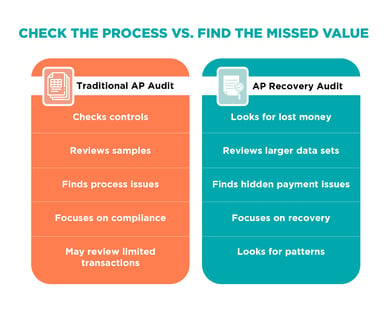
One of the clearest differences between the two approaches is the scope of analysis. A traditional audit may use sampling to make a large dataset manageable. An AP recovery audit can use data-driven analysis to examine much larger transaction populations. This becomes especially valuable for enterprises with millions of invoices and payments.
Consider a supplier that submits similar invoices to three business units. Each business unit may process its own invoices correctly. A traditional review within one business unit may not identify anything unusual. But when payment data is brought together, the same supplier, similar amounts, payment dates, and invoice characteristics may reveal a possible duplicate or overpayment. The broader the view, the easier it becomes to identify patterns that are invisible within individual systems.
Technology Changes the Way Recovery Happens
Technology is another important difference. Traditional audits can involve significant manual work. Teams may spend hours extracting data, cleaning files, comparing transactions, and reviewing documents.
A modern AP recovery audit can use automation and intelligent data analysis to handle much of the initial investigation.
For example, technology can help identify:
- Similar invoices with different invoice numbers
- Duplicate supplier records
- Repeated payment patterns
- Unusual pricing differences
- Payments made across multiple ERP systems
- Transactions that match known leakage patterns
What Happens After an Error Is Found?
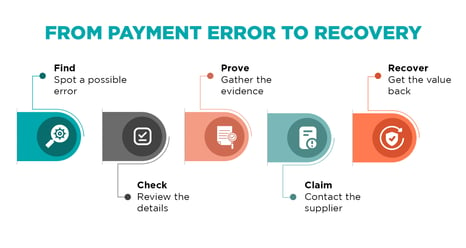
Finding an exception is not the same as recovering money. This is another area where an AP recovery audit can provide greater value.
Once a potential recovery is identified, the finding needs to be validated. The audit team may review invoices, payment records, contracts, purchase orders, supplier information, and other supporting documents. If the finding is confirmed, a recovery claim can be developed.
Depending on the situation, recovery may come through:
- A supplier refund
- A credit memo
- An adjustment to future invoices
- A contract correction
Which Approach Is Right for Your Organization?
The answer depends on what the organization wants to achieve. A traditional AP audit can be useful when the primary objective is to test controls, review compliance, or assess whether established processes are working correctly.
An AP recovery audit is more suitable when the organization wants to uncover missed value across historical transactions and actively pursue recovery opportunities.
For large enterprises, the two approaches do not necessarily need to compete. A finance organization can use traditional audits to assess controls while using recovery audits to identify financial leakage that may have already occurred. The important thing is to understand the purpose of each approach and choose the right method for the business objective.
The Finance Leader's Takeaway
The difference between a traditional AP audit and an AP recovery audit is not simply the technology used. It is the question being asked.
A traditional audit often asks: "Are our processes and controls working?"
A recovery audit asks: "Where have we lost value, and what can we recover?"
For organizations managing large transaction volumes, multiple ERP systems, and complex supplier relationships, that second question can uncover opportunities that routine reviews may miss.
Discover Dollar combines advanced data analysis with audit expertise to help enterprise finance teams identify hidden AP leakage, validate recovery opportunities, and turn findings into measurable results.
Think your AP data may contain missed value? Request a recovery audit from Discover Dollar and find out what your payment history could be hiding.