








Most finance professionals understand that they should conduct accounts payable audits. However, very few know whether what they are paying for those audits actually makes sense.
Are your accounts payable audit costs reasonable compared to your industry peers?
Are you investing enough to detect financial leakage?
Or,
Are you paying for audits that fail to identify the real gaps in your procure-to-pay process?
These questions matter because most organizations never compare their AP audit costs to industry standards. Without benchmarking, finance leaders often operate without knowing whether their audit investment is delivering meaningful returns.
Let's examine how benchmarking works and why it matters.
Why Benchmarking Accounts Payable Audit Cost Matters
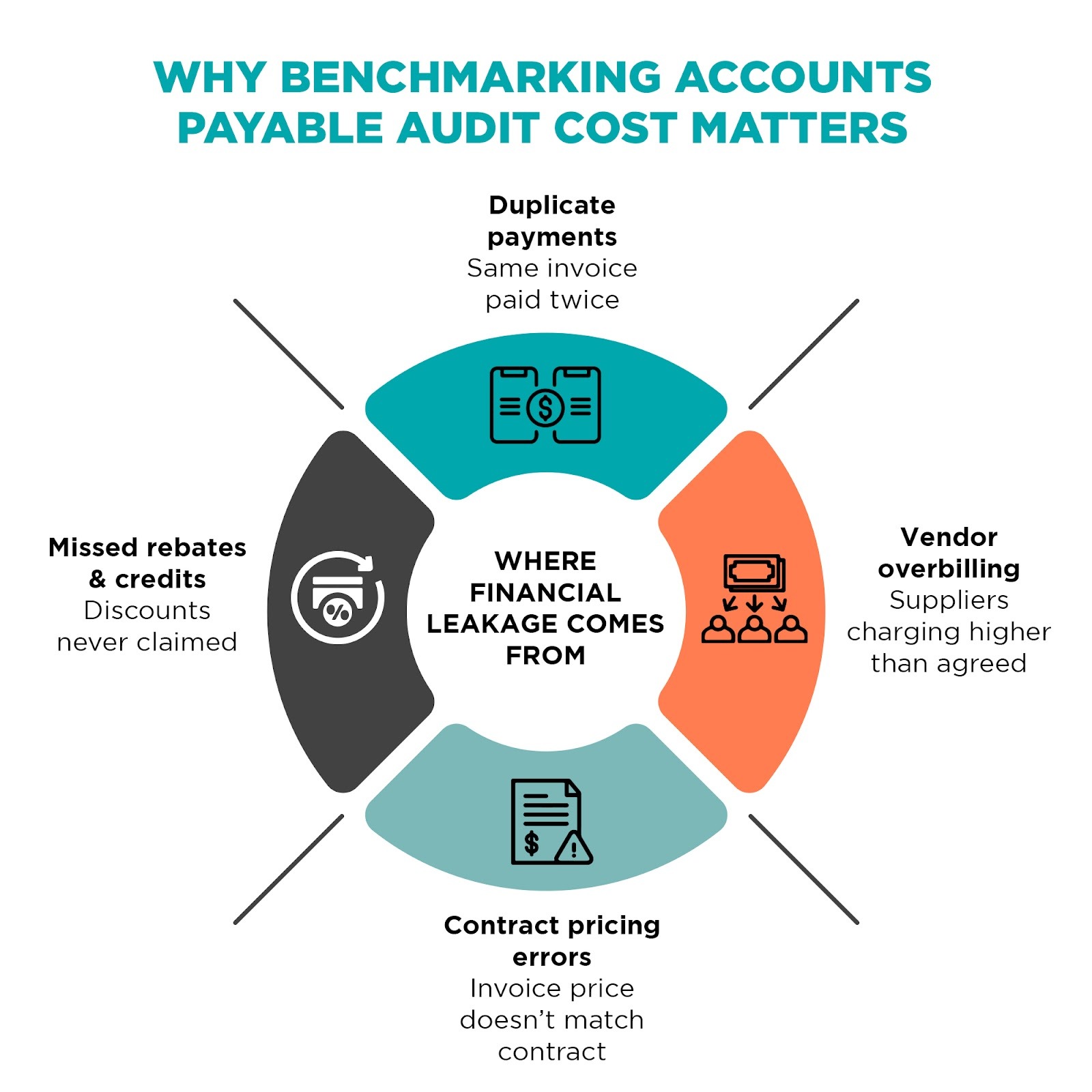
Many organizations fall into one of two categories. Some companies spend too little on accounts payable audit services, which allows duplicate payments, pricing discrepancies, and contract non-compliance to go undetected.
Others spend money on audits but rely on outdated manual audit approaches that deliver limited recovery.
Both scenarios create financial risk.
Consider a company that spends $500 million annually on vendor payments.
This leakage typically comes from:
- Duplicate payments
- Vendor overbilling
- Contract pricing errors
- Missed rebates and credits
Without proper auditing, these issues remain hidden inside millions of transactions.
Benchmarking helps finance leaders determine whether their accounts payable audit pricing is aligned with the recovery value they receive.
What Drives the Cost of an Accounts Payable Audit?
Before benchmarking your AP audit cost, it is important to understand the factors that influence pricing.
Transaction Volume
The more invoices an organization processes, the more data it needs to analyze. High-volume environments require stronger analytics and technology to identify duplicate payments and anomalies.
Vendor Complexity
A company with 500 vendors and simple contracts is easier to audit than a global enterprise managing 5,000 vendors across multiple countries with complex pricing agreements.
Number of ERP Systems
Organizations operating multiple ERP systems face additional challenges in data extraction and reconciliation. Each system adds complexity to the accounts payable audit process.
Audit Scope
Audits focusing only on duplicate payments cost less but recover less value.
Comprehensive audits include:
- Contract compliance checks
- Vendor master data review
- Pricing discrepancy analysis
- Credit recovery
- Spend analytics
Audit Frequency
Annual audits are less expensive upfront, but often miss leakage occurring throughout the year.
Continuous or quarterly audits typically recover 3–4 times more value, especially in large enterprises.
Pricing Model
The pricing model can significantly influence both cost and ROI.
Some providers charge fixed fees, while others operate using contingency-based AP audit models or hybrid structures.
Understanding how pricing works is essential when benchmarking accounts payable audit pricing.
Fixed Fee vs Success Fee: Which Benchmark Delivers Higher ROI?
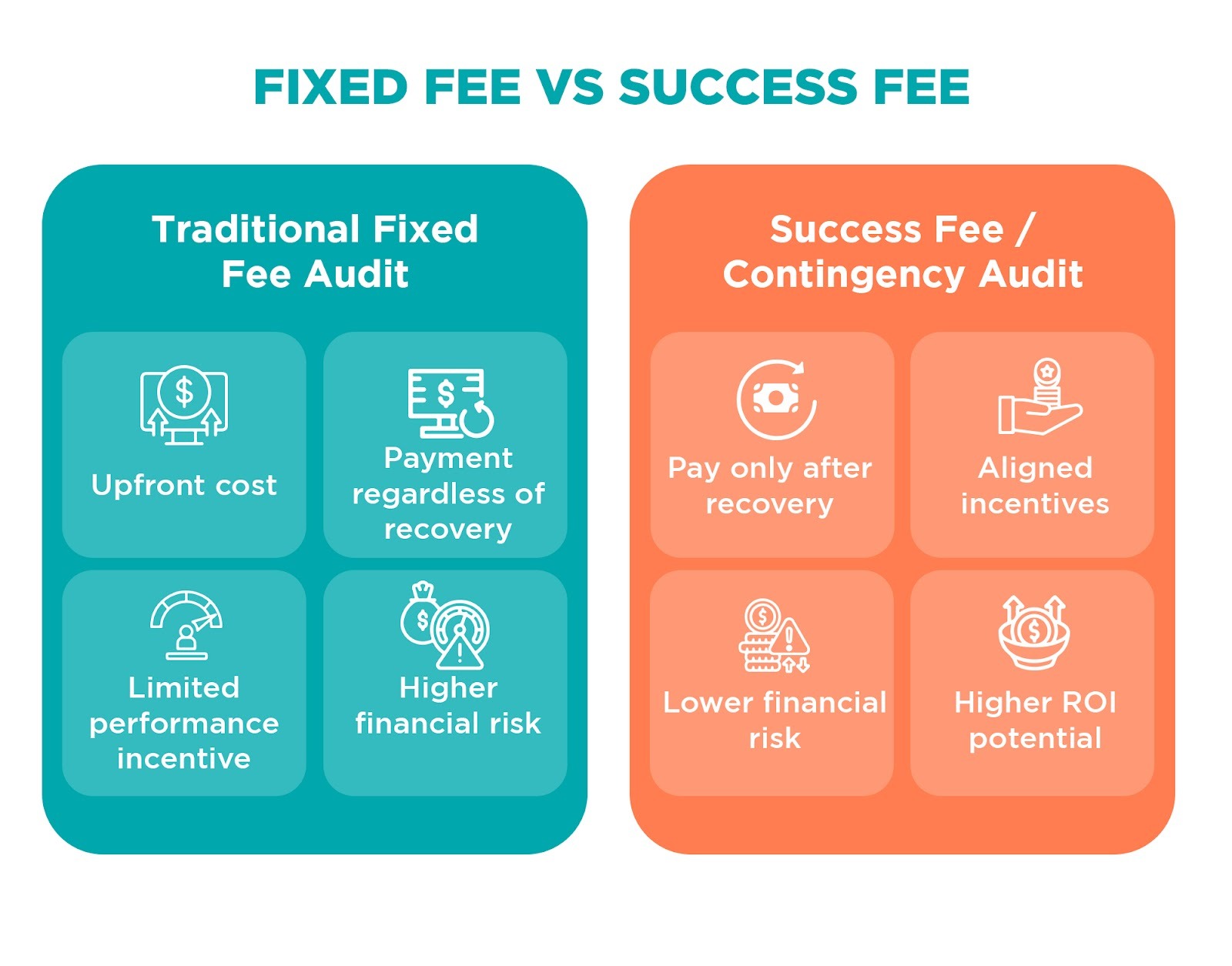
Traditional audit firms typically charge fixed retainers or flat audit fees, regardless of the recovery results they deliver.
In contrast, many modern AI-powered accounts payable audit providers operate using a success-fee model.
Under this approach, organizations pay only after verified recoveries are delivered.
This difference is significant.
A fixed-fee audit model requires companies to commit budget upfront—even if the audit fails to recover meaningful value.
A contingency-based AP audit model, on the other hand, aligns incentives entirely with performance. The provider is compensated only when financial leakage is successfully identified and recovered.
The Most Important Metric: Recovery ROI
Many finance leaders track accounts payable costs per invoice or treat audit expenses as standard operating costs.
However, the most meaningful benchmark is Recovery ROI.
Recovery ROI measures the relationship between:
Total annual recovery ÷ Total audit cost
Leading organizations typically expect a 4x to 10x return on their audit investment.
For example:
- Spend $1 million on audits
- Recover $4–10 million in financial leakage
If your recovery ROI is below 3x, it often indicates:
- Limited audit scope
- Inefficient manual audit methods
- Weak pricing incentives
A true AP audit cost benchmark must also consider risk exposure.
If you pay audit fees upfront regardless of recovery, your ROI ceiling is limited.
A success-fee model removes downside risk, converting audit cost from a fixed expense into a performance-based investment.
Signs Your Current AP Audit Strategy is Failing
Benchmarking often reveals problems that many organizations overlook.
Here are some common warning signs.
You Only Perform Annual Audits
Many leading enterprises now conduct continuous accounts payable recovery audits.
Annual reviews leave large time gaps where leakage can accumulate.
Your Audit Scope Is Too Narrow
Audits that focus only on duplicate payments miss major recovery opportunities.
Comprehensive accounts payable recovery audit services examine multiple leakage scenarios.
Your Audits Are Manual
Manual reviews struggle to keep up with modern transaction volumes.
An AI-powered accounts payable audit can analyze millions of transactions quickly and identify complex leakage patterns.
Recovery Has Stagnated
If every audit produces the same recovery results, the program is likely missing new sources of financial leakage.
Best-in-Class AP Audit Performers Do this Differently
Benchmarking only creates value if organizations act on the insights it provides.
Top-performing companies focus on intelligent audit investment, not simply spending more.
They adopt modern approaches such as:
- AI-powered accounts payable audit technology
- Continuous recovery monitoring
- Cross-system transaction analysis
- Automated contract-to-invoice matching
These capabilities allow organizations to detect financial leakage across hundreds of risk scenarios.
Instead of overspending on manual audits, leading companies invest in systems that maximize recovery value while reducing operational cost.
Final Words
Most finance executives already suspect their accounts payable audit program is not operating at peak efficiency. Transaction volumes are rising. Vendor ecosystems are expanding. ERP environments are becoming more complex.
Without benchmarking your AP audit cost against recovery value, it becomes difficult to know whether your organization is protecting its financial resources effectively. This is where Discover Dollar stands apart.
Using advanced AI-powered accounts payable audit technology, Discover Dollar analyzes transactions across multiple ERP systems to detect duplicate payments, contract non-compliance, missed credits, and other sources of financial leakage. The result is simple: higher recovery value with zero financial risk.
If you want to understand whether your accounts payable audit costs are aligned with industry benchmarks, connect with Discover Dollar today or schedule a demo to see how a smarter, performance-driven audit strategy can transform your recovery outcomes.